



Number №4, 2025
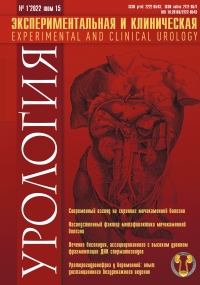
Modern trends in the treatment of hypospadias in the Russian Federation Metabolic conditions for the formation of calcium oxalate urinary stones A comprehensive approach to the treatment of chronic encrusting cystitis Voiding diary: clinical significance and prospects for digitalization
Number №3, 2025
First analysis of laboratory adherence in the Russian Federation to the sixth edition of the WHO laboratory manual for the examination and processing of human semen
Number №2, 2025
Post-Void Residual Urine Ratio (PVR-R) as a prognostic marker of chronic kidney disease in men with benign prostate hyperplasia
Number №1, 2025
The effect of testosterone replacement therapy on lower urinary tract symptoms (LUTS) in men
Number №4, 2024
The structure of damage of the genitourinary system in modern armed conflict
Number №3, 2024
Cost-effectiveness of urinary incontinence treatment in a short-stay hospital
Number №2, 2024
Complex medicines for correction of urine pH level during urolithiasis metaphylaxis
Number №1, 2024
Moscow program on histofusion biopsy of the prostate: results of a survey of practicing urologists based on data from a multicenter study
Number №4, 2023
Possibilities for improving the therapeutic activity of bacteriophage preparations Urological complications after renal transplantation
Number №3, 2023
Regulatory and legal possibilities for metaphylaxis of urolithiasis in the Russian Federation
Number №2, 2023
Frequency and nature of symptoms of dysfunction of the lower urinary tract in persons over 40 years old Postcoital cystitis as a cause of sexual dysfunction in women
Number №4, 2022
Surgical treatment of inferior vena cava tumor thrombus X-ray-free ureterolithotripsy for ureteral stones
Number №3, 2022
Brachytherapy for prostate cancer and immune response Risk factors for nephrolithiasis after radical cystectomy with intestinal plasty of the bladder
Number №2, 2022
The incidence of urolithiasis in the Russian Federation from 2005 to 2020 Urolithiasis and the risk of myocardial infarction and stroke
Number №1, 2022
A modern view on the screening of urolithiasis Hereditary factor of metaphylaxis of urolithiasis Treatment of infertility associated with a high level of sperm DNA fragmentation
Number №4, 2021
COVID-19 associated encrusting cystitis Endoscopic correction of vesicoureteral reflux in children: differentiated choice of method, material and dosage
Number №3, 2021
Artificial intelligence in urology oncology Mini-percutaneous nephrolithotomy without ureteral catheterization. Comparison with the standard method
Number №1, 2021
Epidemiological study of the prevalence of cystitis in women in the Voronezh region Congenital anomalies of the penis: world and domestic data
Number №5, 2020
Isolated kidney injury: international guidelines and Moscow standards
Number №3, 2020
Epidemiology of neurogenic urinary disorders. Treatment outcomes for high-risk prostate cancer patients: a multicenter analysis
Number №2, 2020
COVID-19: Impact on the Urological Service of the Russian Federation Genitourinary system and Covid-19: some aspects
Number №1, 2020
Distance education in urology. Experience 2012-2019 Inpatient care for urological patients in the context of the COVID-19 pandemic
Number №4, 2019
Male infertility in the Russian Federation: statistics for 2000-2018 Evaluation of the effectiveness of perineum muscle training in restoring erectile function
Number №3, 2019
Epidemiology of urolithiasis in the Perm region: results of a 30-year study The economic and economic rationale for the use of modern methods of treating urolithiasis
Номер №4, 2018
Incidence of ICD in the Russian Federation (2005-2016) Screening for prostate cancer: modern presentation and organization Primary multiple transitional cell epithelium Androgenic screening in men over 50 years
Номер №3, 2018
The role of stem cells in the treatment of urinary incontinence Percutaneous nephrolithotripsy in infected urine Testicular Prosthesis in Children and Adolescents: Results from a Multicenter Study Premature ejaculation is the current state of the problem.
Number №2, 2018
Alternative methods of treatment of localized prostate cancer Partial doubling of the urethra: paraurethral motion Comparative review of disposable flexible ureteronephroscope
Number №1, 2018
The prevalence of symptoms of impairment of the function of the lower urinary tract in men according to the results of a population study Patient-centered system of organization of medical care in urology using...
Number №4, 2017
Predicting the development of erectile dysfunction and cardiovascular diseases Prognostic factors of survival of patients with prostate cancer
Number №3, 2017
Recommendations for the treatment of prostate cancer with the help of high-power interstitial radiation therapy (brachytherapy)
Number №2, 2017

Radioisotope lymphoscintigraphy with PCa
Metabolic risk factors and formation of urinary stones
Ureteral amputation in the performance of contact ureterolithotrypsy

Number №1, 2017
Principles of «4P Medicine» in the organization of health care in the context of urological diseases Changes in the electrolyte composition of urine under the influence of sodium hypochlorite. The possibility of reducing the risk of recurrence of nephrolithiasis
Number №4, 2016
Preliminary results of a multicenter study of prostate cancer Analysis of specialized medical care for patients with gross hematuria, renal colic.
Number №3, 2016
Techniques for preserving continence after robot-prostatectomy The protective partial nephrectomy for renal cell carcinoma
Number №2, 2016
Медицинская помощь пациентам с острой задержкой мочеиспускания Прогностическое значение истинного кастрационного уровня тестостерона..
Number №1, 2016
The analysis of the accuracy of factors for the survival predictiry after radical cystectomy Citokine status in pathients with recurrent urinary tract infection
Number №4, 2015

Modern demographic situation in Russia Determination of gene mutations FGFR3 and PIK3CA DNA urine sediment from patients with bladder cancerя

Number №3, 2015
Neuroendocrine differentiation in cancer prostate. The role of viruses in carcinogenesis of bladder cancer.
Number №2, 2015
Clinical and economic evaluation of prostate cancer screening The combination RSAZ TMPRSS2-ERG in the diagnosis of prostate cancer: first experience
Number №1, 2015
The role of distance education in improving primary health care professionals. Comparative analysis of the results of cancer radical retropubic and robot-assisted prostatectomy.
Number №4, 2014
Experience of clinical and economical treatment cancer patients Comparison of analysis details for open, laparoscopic and robot-assisted nephrectomy in the..
Number №3, 2014
Medical and economic aspects of a comprehensive standardized program-stage diagnosis and treatment of benign prostatic hyperplasia
Number №2, 2014
Uronephrological morbidity and mortality in Russia in 2002-2012 Androgens and chronic ischemia PCA3 test-system: first results
Number №1, 2014
First results of standardized programme for BPH diagnosis and treatment Evaluation of serum Chromogranin A levels in different prostatic diseases Retarded ejaculation is a rare diagnosis
Number №4, 2013
Distance education in urology brachytherapy prostate cancer Erectile dysfunction and cardiovascular ...
Number №3, 2013
The incidence of kidney stones... HIFU-treatment of local recurrence of cancer... Non-prostatic sources of prostate...
Number №2, 2013
Risk factors for the development
of the urolithiasis in patients
with the metabolic syndrome
Number №1, 2013
Clinical and economic analysis of the surgical treatment of prostate cancer Brachytherapy prostate cancer: postimplantnaya dosimetry and dependence ... Simulation prostatic carcinogenesis
Number №4, 2012
Урологическая заболеваемость в Нижегородской области Стресс, метаболический синдром и хроническая болезнь почек TVT - 10 лет в России
Eksperimental'naya i klinicheskaya urologiya

Conflict of interest polity

4506

To exclude cases of publication ethics violation, the conflict of interest of all parties involved in the publication process should be excluded. A conflict of interest arises if the author, reviewer, or member of the editorial board has financial, scientific, or personal relationships that could affect their actions. Such relationships are called dual obligations, competing interests, or competing loyalty.

In order to avoid conflicts of interest, in accordance with the journal ethical standards, the following responsibilities are assigned to each of the parties.

The editor’s responsibilities:

  • to transfer the article text for examination to another member of the editorial board if the originally selected reviewer has a conflict of interest with the author of the article considered for publication in the journal;
  • to request information from all participants in the publication process about the possibility of competing interests;
  • to make a decision on the publication of information indicated in the author’s letter regarding a conflict of scientific and / or financial interests, if this information is not confidential and may affect the evaluation of the published work by a reader or a scientific community;
  • to ensure the publication of amendments if the information on a conflict of interest was obtained after the publication of the article.

Unpublished data obtained from manuscripts submitted cannot be used in personal research without a written consent of the author. Information or ideas obtained during the peer review process and related to potential benefits should be kept confidential and not used for personal gain.

Editors should not review manuscripts in case of conflicts of interest due to competitive, collaborative and other interactions and relationships with authors.

Editors should regularly publish disclosures about potential conflicts of interest related to journal staff obligations.

The author’s responsibilities:

  • to provide in a cover letter existing and possible sources of conflict of interest;
  • to indicate the organization affiliated with the author (one or several) and sources of funding for the study;
  • if there is no conflict of interest, indicate this in the application for publication.

When submitting an article, the authors are responsible for disclosing all financial or personal relationships that could affect their work. All authors are required to disclose in their manuscripts potential conflicts of interest, that may be perceived as having an impact on the results or conclusions presented in the work.

The reviewer’s responsibilities:

  • to inform the chief editor about the existing conflict of interests (double obligations, competing interests)
  • to refuse to conduct an examination of the text of the article.

Information or ideas obtained during the peer review process and related to potential benefits should be kept confidential and not used for personal gain.


<< Step back to Editorial Policy

Яндекс.Метрика