

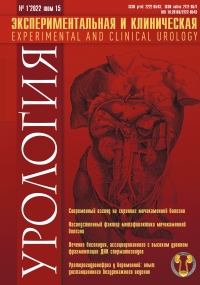


Number №3, 2025
First analysis of laboratory adherence in the Russian Federation to the sixth edition of the WHO laboratory manual for the examination and processing of human semen
Number №2, 2025
Post-Void Residual Urine Ratio (PVR-R) as a prognostic marker of chronic kidney disease in men with benign prostate hyperplasia
Number №1, 2025
The effect of testosterone replacement therapy on lower urinary tract symptoms (LUTS) in men
Number №4, 2024
The structure of damage of the genitourinary system in modern armed conflict
Number №3, 2024
Cost-effectiveness of urinary incontinence treatment in a short-stay hospital
Number №2, 2024
Complex medicines for correction of urine pH level during urolithiasis metaphylaxis
Number №1, 2024
Moscow program on histofusion biopsy of the prostate: results of a survey of practicing urologists based on data from a multicenter study
Number №4, 2023
Possibilities for improving the therapeutic activity of bacteriophage preparations Urological complications after renal transplantation
Number №3, 2023
Regulatory and legal possibilities for metaphylaxis of urolithiasis in the Russian Federation
Number №2, 2023
Frequency and nature of symptoms of dysfunction of the lower urinary tract in persons over 40 years old Postcoital cystitis as a cause of sexual dysfunction in women
Number №4, 2022
Surgical treatment of inferior vena cava tumor thrombus X-ray-free ureterolithotripsy for ureteral stones
Number №3, 2022
Brachytherapy for prostate cancer and immune response Risk factors for nephrolithiasis after radical cystectomy with intestinal plasty of the bladder
Number №2, 2022
The incidence of urolithiasis in the Russian Federation from 2005 to 2020 Urolithiasis and the risk of myocardial infarction and stroke
Number №1, 2022
A modern view on the screening of urolithiasis Hereditary factor of metaphylaxis of urolithiasis Treatment of infertility associated with a high level of sperm DNA fragmentation
Number №4, 2021
COVID-19 associated encrusting cystitis Endoscopic correction of vesicoureteral reflux in children: differentiated choice of method, material and dosage
Number №3, 2021
Artificial intelligence in urology oncology Mini-percutaneous nephrolithotomy without ureteral catheterization. Comparison with the standard method
Number №1, 2021
Epidemiological study of the prevalence of cystitis in women in the Voronezh region Congenital anomalies of the penis: world and domestic data
Number №5, 2020
Isolated kidney injury: international guidelines and Moscow standards
Number №3, 2020
Epidemiology of neurogenic urinary disorders. Treatment outcomes for high-risk prostate cancer patients: a multicenter analysis
Number №2, 2020
COVID-19: Impact on the Urological Service of the Russian Federation Genitourinary system and Covid-19: some aspects
Number №1, 2020
Distance education in urology. Experience 2012-2019 Inpatient care for urological patients in the context of the COVID-19 pandemic
Number №4, 2019
Male infertility in the Russian Federation: statistics for 2000-2018 Evaluation of the effectiveness of perineum muscle training in restoring erectile function
Number №3, 2019
Epidemiology of urolithiasis in the Perm region: results of a 30-year study The economic and economic rationale for the use of modern methods of treating urolithiasis
Номер №4, 2018
Incidence of ICD in the Russian Federation (2005-2016) Screening for prostate cancer: modern presentation and organization Primary multiple transitional cell epithelium Androgenic screening in men over 50 years
Номер №3, 2018
The role of stem cells in the treatment of urinary incontinence Percutaneous nephrolithotripsy in infected urine Testicular Prosthesis in Children and Adolescents: Results from a Multicenter Study Premature ejaculation is the current state of the problem.
Number №2, 2018
Alternative methods of treatment of localized prostate cancer Partial doubling of the urethra: paraurethral motion Comparative review of disposable flexible ureteronephroscope
Number №1, 2018
The prevalence of symptoms of impairment of the function of the lower urinary tract in men according to the results of a population study Patient-centered system of organization of medical care in urology using...
Number №4, 2017
Predicting the development of erectile dysfunction and cardiovascular diseases Prognostic factors of survival of patients with prostate cancer
Number №3, 2017
Recommendations for the treatment of prostate cancer with the help of high-power interstitial radiation therapy (brachytherapy)
Number №2, 2017

Radioisotope lymphoscintigraphy with PCa
Metabolic risk factors and formation of urinary stones
Ureteral amputation in the performance of contact ureterolithotrypsy

Number №1, 2017
Principles of «4P Medicine» in the organization of health care in the context of urological diseases Changes in the electrolyte composition of urine under the influence of sodium hypochlorite. The possibility of reducing the risk of recurrence of nephrolithiasis
Number №4, 2016
Preliminary results of a multicenter study of prostate cancer Analysis of specialized medical care for patients with gross hematuria, renal colic.
Number №3, 2016
Techniques for preserving continence after robot-prostatectomy The protective partial nephrectomy for renal cell carcinoma
Number №2, 2016
Медицинская помощь пациентам с острой задержкой мочеиспускания Прогностическое значение истинного кастрационного уровня тестостерона..
Number №1, 2016
The analysis of the accuracy of factors for the survival predictiry after radical cystectomy Citokine status in pathients with recurrent urinary tract infection
Number №4, 2015

Modern demographic situation in Russia Determination of gene mutations FGFR3 and PIK3CA DNA urine sediment from patients with bladder cancerя

Number №3, 2015
Neuroendocrine differentiation in cancer prostate. The role of viruses in carcinogenesis of bladder cancer.
Number №2, 2015
Clinical and economic evaluation of prostate cancer screening The combination RSAZ TMPRSS2-ERG in the diagnosis of prostate cancer: first experience
Number №1, 2015
The role of distance education in improving primary health care professionals. Comparative analysis of the results of cancer radical retropubic and robot-assisted prostatectomy.
Number №4, 2014
Experience of clinical and economical treatment cancer patients Comparison of analysis details for open, laparoscopic and robot-assisted nephrectomy in the..
Number №3, 2014
Medical and economic aspects of a comprehensive standardized program-stage diagnosis and treatment of benign prostatic hyperplasia
Number №2, 2014
Uronephrological morbidity and mortality in Russia in 2002-2012 Androgens and chronic ischemia PCA3 test-system: first results
Number №1, 2014
First results of standardized programme for BPH diagnosis and treatment Evaluation of serum Chromogranin A levels in different prostatic diseases Retarded ejaculation is a rare diagnosis
Number №4, 2013
Distance education in urology brachytherapy prostate cancer Erectile dysfunction and cardiovascular ...
Number №3, 2013
The incidence of kidney stones... HIFU-treatment of local recurrence of cancer... Non-prostatic sources of prostate...
Number №2, 2013
Risk factors for the development
of the urolithiasis in patients
with the metabolic syndrome
Number №1, 2013
Clinical and economic analysis of the surgical treatment of prostate cancer Brachytherapy prostate cancer: postimplantnaya dosimetry and dependence ... Simulation prostatic carcinogenesis
Number №4, 2012
Урологическая заболеваемость в Нижегородской области Стресс, метаболический синдром и хроническая болезнь почек TVT - 10 лет в России
Eksperimental'naya i klinicheskaya urologiya

Oleg Ivanovich Apolikhin

Oleg Ivanovich Apolikhin was born in 1960.

In 1983 he graduated from the N.N. Burdenko Voronezh State Medical Institute. From 1984 until 1986 he worked as a surgeon at Voronezh city hospital. From 1986 until 1991 he was an urologist and andrologist at FSI “Urology Research Institute” of Federal Agency for High Technological Medical Help of Russia. From 1991 until 1997 he was the head of innovation department at Urology Research Institute. From 1997 until 2000 he was the head of medical and sanatorium services department at PJSC “Gazprom”. In 2000 O.I. Apolikhin was appointed to the position of deputy director of Urology Research Institute. Since 2007 he holds the position of director of FSI “Urology Research Institute” of the Ministry of Health of Russia.

O.I. Apolikhin possesses the highest category of qualification in urological speciality (2001) and an academic degree of doctor of medical science (1997): the topic of doctoral dissertation is “Thermotherapy for benign prostatic hyperplasia”. He holds the academic status of professor of urology (2003).

O.I. Apolikhin is a leading scientist and administrator, who made a great contribution to the development of Russian urology. Being a highly qualified urology specialist, O.I. Apolikhin significantly improved his education and skills while learning abroad:

  • 1995 – Medical Technology University (ACTIM), France, Faculty of medical economics; “Healthcare economics and application of new technologies and modern equipment” course.
  • 2000-2001 – University of Oxford (Great Britain), MBA faculty, course in medical ethics and administrative law in healthcare.
  • 2001 – University of Oxford (Great Britain), course in evidence-based medicine.

Professor O.I. Apolikhin is engaged in numerous scientific and educational activities. The main directions of his scientific research are:

  • organization of urological care for the population of Russian Federation
  • health economics
  • early diagnosis of prostate diseases
  • minimally invasive methods for diagnosis and treatment of urological diseases
  • standards development in urological care
  • multidisciplinary approach to sexual and erectile dysfunction research

In his practical work and research O.I. Apolikhin has proven to be an erudite scientist and extraordinary administrator. Modern minimally invasive modalities of treatment for management of uro-oncological patients, such as brachytherapy, high intensity focused ultrasound (HIFU) ablation, cryoablation and photodynamic therapy, were introduced into clinical practice of Institute on his initiative. Laparoscopic methods of treatment for urological diseases were introduced and are currently used. Laboratory of urodynamic studies and functional disorders of the pelvis was created and now functions successfully. Institute is equipped with a fully functional training facility for young doctors, which is outfitted with the most advanced hardware and computer simulators.

Russian and international scientific clinical trials are performed at the Urology Research Institute under the guidance of professor O.I. Apolikhin.

O.I. Apolikhin is the member of the board of Russian Society of Urology, supervising international relations and education.

Telemedicine department was first created in Urology Research Institute on the initiative of O.I. Apolikhin; web resources addressed towards professional urologists, highlighting world wide scientific achievements in urology on a regular basis, became operational.

International scientific and practical conferences and workshops are held regularly, in which the world's leading experts participate, performing demonstrative surgical interventions together with Russian scientists with the use of newest technological advancements. All scientific events held by the Institute are translated via the telemedicine channels to attract the wide audience of professional urologists.

O.I. Apolikhin has first created a productive system of international consultations, which attracts the world-class experts in urology with the use of advanced translation equipment.

Thanks to professor O.I. Apolikhin, Urology Research Institute maintains close scientific and practical contacts with colleagues from all over Russia and CIS in the form of direct working arrangements with country's leading medical educational institutions and urology departments. Joint programs are conducted with several regions. For example, a pilot project dedicated to step-by-step standardization of urological care in Voronezh region was started in 2009. From November 2009 until November 2010 office consultations for male population of several towns and villages of the region were arranged; specialists from Urology Research Institute have performed initial consulting of patients and teaching of local doctors; remote telemedicine connection with distant districts was installed. Such level of interaction provides succession in providing healthcare, which greatly improves the long-term results of treatment.

In the end of 2010, a sub-program titled “Urology” was ratified in the context of a long-term regional target program “Development of healthcare in Voronezh region in 2011-2015”. It is based on a program developed and approved in practice in Urology Research Institute under the leadership of O.I. Apolikhin.

As a result, clinical, economical and statistical data was received, which allowed to create a concept of development of urological care in the region. A step-by-step model of organizing medical care for the patients with urological diseases was created. A document set, which includes legal regulations and standards, was developed. Program of communication with general population using mass media was created and approved. Today, the Program, developed by O.I. Apolikhin, begins to work in 5 subjects of Russian Federation, and several are going through the pre-Program evaluation. Interest towards the Program was expressed in 15 regions of Russia.

O.I. Apolikhin is the chief editor of “Experimental and clinical urology” journal and “International abstract journal «Urology»”. He secured the free distribution of these journals among the urologists of Russia. More than 2000 urologists all over Russia and CIS are subscribed to them.

Professor is a member of editorial board of “Urology” journal.

More than 500 scientific papers, including monographs, have been written under the guidance of O.I. Apolikhin.

6 candidates' and 1 doctoral dissertations have been defended with him as an academic adviser; and 2 more doctoral and 1 candidate's dissertations are being worked on currently, dedicated to urodynamics of urinary tract, diagnosis and treatment of benign prostatic hyperplasia and chronic prostatitis and economical efficiency of different types of surgery for prostate cancer.

O.I. Apolikhin is the author of two Russian Federation patents.

O.I. Apolikhin is a full member of European association of urology, American urological association, Royal society of medicine (United Kingdom) and International society of urology (France). With perfect knowledge of English and Spanish languages, professor O.I. Apolikhin represents Urology Research Institute and Russian urology on international medical conferences.

Currently, O.I. Apolikhin holds the post of chief specialist in reproductive health at the Ministry of Health of Russia.

Scientific, practical and organizing work of professor O.I. Apolikhin allows to define him as a major scientist and administrator.

Among the staff, O.I. Apolikhin has great authority and is held in sincere respect.