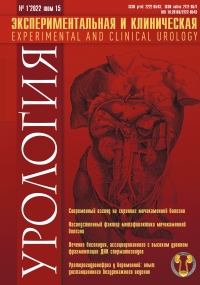
Features of the management tactics for patients with varicocele in various regions of the Russian Federation according to the results of a survey of specialists
Modern trends in the treatment of hypospadias in the Russian Federation
Metabolic conditions for the formation of calcium oxalate urinary stones
A comprehensive approach to the treatment of chronic encrusting cystitis
Voiding diary: clinical significance and prospects for digitalization
First analysis of laboratory adherence in the Russian Federation to the sixth edition of the WHO laboratory manual for the examination and processing of human semen
Frequency and nature of symptoms of dysfunction of the lower urinary tract in persons over 40 years old
Postcoital cystitis as a cause of sexual dysfunction in women
A modern view on the screening of urolithiasis
Hereditary factor of metaphylaxis of urolithiasis
Treatment of infertility associated with a high level of sperm DNA fragmentation
COVID-19 associated encrusting cystitis
Endoscopic correction of vesicoureteral reflux in children: differentiated choice of method, material and dosage
Male infertility in the Russian Federation: statistics for 2000-2018
Evaluation of the effectiveness of perineum muscle training in restoring erectile function
Epidemiology of urolithiasis in the Perm region: results of a 30-year study
The economic and economic rationale for the use of modern methods of treating urolithiasis
Incidence of ICD in the Russian Federation (2005-2016)
Screening for prostate cancer: modern presentation and organization
Primary multiple transitional cell epithelium
Androgenic screening in men over 50 years
The role of stem cells in the treatment of urinary incontinence
Percutaneous nephrolithotripsy in infected urine
Testicular Prosthesis in Children and Adolescents: Results from a Multicenter Study
Premature ejaculation is the current state of the problem.
Alternative methods of treatment of localized prostate cancer
Partial doubling of the urethra: paraurethral motion
Comparative review of disposable flexible ureteronephroscope
The prevalence of symptoms of impairment of the function of the lower urinary tract in men according to the results of a population study
Patient-centered system of organization of medical care in urology using...
Radioisotope lymphoscintigraphy with PCa
Metabolic risk factors and formation of urinary stones
Ureteral amputation in the performance of contact ureterolithotrypsy
Principles of «4P Medicine» in the organization of health care in the context of urological diseases
Changes in the electrolyte composition of urine under the influence of sodium hypochlorite. The possibility
of reducing the risk of recurrence of nephrolithiasis
The analysis of the accuracy of factors for the survival predictiry after radical cystectomy
Citokine status in pathients with recurrent urinary tract infection
The role of distance education in improving primary health care professionals.
Comparative analysis of the results of cancer radical retropubic and robot-assisted prostatectomy.
Experience of clinical and economical treatment cancer patients
Comparison of analysis details for open, laparoscopic
and robot-assisted nephrectomy in the..
First results of standardized programme for BPH diagnosis and treatment
Evaluation of serum Chromogranin A levels in different prostatic diseases
Retarded ejaculation is a rare diagnosis
Clinical and economic analysis of the surgical treatment of prostate cancer
Brachytherapy prostate cancer: postimplantnaya dosimetry and dependence ...
Simulation prostatic carcinogenesis
This article is dedicated to the history of Russian andrology, that appeared as a part of urology. Separation of urology from clinical surgery took place in the early fifties of 19th century and was connected with a name of medical surgery academy professor P.P. Zabolovskij– Desjatovskij. This article emphasizes that formation of urology as an independent discipline led to organization of first Russian urological department under the Moscow university in 1866. In the middle of 20th century under the surgical departments of clinics in Moscow, Saint-Petersburg, Kharkov, Kiev, Odessa, Rostov-on- Don urological departments began to appear, in which there were andrologists who treated patients with genitalia diseases. Rapid development of andrology took place in 80's of 20th century. Andrological department headed by V.G. Gorjunov was organized under the scientific research institute of urology founded by prof. N.A. Lopatkin. During this years great contribution into the development of andrology was made by pofessors Ju.A. Pytel', O.L. Tiktinskij, V.I. Krasulin, V.I. Rusakov, Ju.G. Aljaev, O. B. Loran, M.I. Kogan, A.A. Kamalov. Organized and registered in 1996 Professional Association of Andrologists in 2001 got national status. Currently andrological science in scientific research institute of urology headed by prof. Apolikhin O.I. rapidly develops, male healthcare government program is being developed and introduced. The role of scientific research institute of urology in the development of andrology and it's connection with other disciplines was emphasized.
Сайт журнала "Экспериментальная и клиническая урология" содержит материалы
медицинского характера, предназначенные исключительно для работников
здравоохранения.
Подтвердите, пожалуйста, что Вы являетесь медицинским работником с соответствующим
дипломом или студентом медицинского образовательного учреждения.