




Number №3, 2025
First analysis of laboratory adherence in the Russian Federation to the sixth edition of the WHO laboratory manual for the examination and processing of human semen
Number №2, 2025
Post-Void Residual Urine Ratio (PVR-R) as a prognostic marker of chronic kidney disease in men with benign prostate hyperplasia
Number №1, 2025
The effect of testosterone replacement therapy on lower urinary tract symptoms (LUTS) in men
Number №4, 2024
The structure of damage of the genitourinary system in modern armed conflict
Number №3, 2024
Cost-effectiveness of urinary incontinence treatment in a short-stay hospital
Number №2, 2024
Complex medicines for correction of urine pH level during urolithiasis metaphylaxis
Number №1, 2024
Moscow program on histofusion biopsy of the prostate: results of a survey of practicing urologists based on data from a multicenter study
Number №4, 2023
Possibilities for improving the therapeutic activity of bacteriophage preparations Urological complications after renal transplantation
Number №3, 2023
Regulatory and legal possibilities for metaphylaxis of urolithiasis in the Russian Federation
Number №2, 2023
Frequency and nature of symptoms of dysfunction of the lower urinary tract in persons over 40 years old Postcoital cystitis as a cause of sexual dysfunction in women
Number №4, 2022
Surgical treatment of inferior vena cava tumor thrombus X-ray-free ureterolithotripsy for ureteral stones
Number №3, 2022
Brachytherapy for prostate cancer and immune response Risk factors for nephrolithiasis after radical cystectomy with intestinal plasty of the bladder
Number №2, 2022
The incidence of urolithiasis in the Russian Federation from 2005 to 2020 Urolithiasis and the risk of myocardial infarction and stroke
Number №1, 2022
A modern view on the screening of urolithiasis Hereditary factor of metaphylaxis of urolithiasis Treatment of infertility associated with a high level of sperm DNA fragmentation
Number №4, 2021
COVID-19 associated encrusting cystitis Endoscopic correction of vesicoureteral reflux in children: differentiated choice of method, material and dosage
Number №3, 2021
Artificial intelligence in urology oncology Mini-percutaneous nephrolithotomy without ureteral catheterization. Comparison with the standard method
Number №1, 2021
Epidemiological study of the prevalence of cystitis in women in the Voronezh region Congenital anomalies of the penis: world and domestic data
Number №5, 2020
Isolated kidney injury: international guidelines and Moscow standards
Number №3, 2020
Epidemiology of neurogenic urinary disorders. Treatment outcomes for high-risk prostate cancer patients: a multicenter analysis
Number №2, 2020
COVID-19: Impact on the Urological Service of the Russian Federation Genitourinary system and Covid-19: some aspects
Number №1, 2020
Distance education in urology. Experience 2012-2019 Inpatient care for urological patients in the context of the COVID-19 pandemic
Number №4, 2019
Male infertility in the Russian Federation: statistics for 2000-2018 Evaluation of the effectiveness of perineum muscle training in restoring erectile function
Number №3, 2019
Epidemiology of urolithiasis in the Perm region: results of a 30-year study The economic and economic rationale for the use of modern methods of treating urolithiasis
Номер №4, 2018
Incidence of ICD in the Russian Federation (2005-2016) Screening for prostate cancer: modern presentation and organization Primary multiple transitional cell epithelium Androgenic screening in men over 50 years
Номер №3, 2018
The role of stem cells in the treatment of urinary incontinence Percutaneous nephrolithotripsy in infected urine Testicular Prosthesis in Children and Adolescents: Results from a Multicenter Study Premature ejaculation is the current state of the problem.
Number №2, 2018
Alternative methods of treatment of localized prostate cancer Partial doubling of the urethra: paraurethral motion Comparative review of disposable flexible ureteronephroscope
Number №1, 2018
The prevalence of symptoms of impairment of the function of the lower urinary tract in men according to the results of a population study Patient-centered system of organization of medical care in urology using...
Number №4, 2017
Predicting the development of erectile dysfunction and cardiovascular diseases Prognostic factors of survival of patients with prostate cancer
Number №3, 2017
Recommendations for the treatment of prostate cancer with the help of high-power interstitial radiation therapy (brachytherapy)
Number №2, 2017

Radioisotope lymphoscintigraphy with PCa
Metabolic risk factors and formation of urinary stones
Ureteral amputation in the performance of contact ureterolithotrypsy

Number №1, 2017
Principles of «4P Medicine» in the organization of health care in the context of urological diseases Changes in the electrolyte composition of urine under the influence of sodium hypochlorite. The possibility of reducing the risk of recurrence of nephrolithiasis
Number №4, 2016
Preliminary results of a multicenter study of prostate cancer Analysis of specialized medical care for patients with gross hematuria, renal colic.
Number №3, 2016
Techniques for preserving continence after robot-prostatectomy The protective partial nephrectomy for renal cell carcinoma
Number №2, 2016
Медицинская помощь пациентам с острой задержкой мочеиспускания Прогностическое значение истинного кастрационного уровня тестостерона..
Number №1, 2016
The analysis of the accuracy of factors for the survival predictiry after radical cystectomy Citokine status in pathients with recurrent urinary tract infection
Number №4, 2015

Modern demographic situation in Russia Determination of gene mutations FGFR3 and PIK3CA DNA urine sediment from patients with bladder cancerя

Number №3, 2015
Neuroendocrine differentiation in cancer prostate. The role of viruses in carcinogenesis of bladder cancer.
Number №2, 2015
Clinical and economic evaluation of prostate cancer screening The combination RSAZ TMPRSS2-ERG in the diagnosis of prostate cancer: first experience
Number №1, 2015
The role of distance education in improving primary health care professionals. Comparative analysis of the results of cancer radical retropubic and robot-assisted prostatectomy.
Number №4, 2014
Experience of clinical and economical treatment cancer patients Comparison of analysis details for open, laparoscopic and robot-assisted nephrectomy in the..
Number №3, 2014
Medical and economic aspects of a comprehensive standardized program-stage diagnosis and treatment of benign prostatic hyperplasia
Number №2, 2014
Uronephrological morbidity and mortality in Russia in 2002-2012 Androgens and chronic ischemia PCA3 test-system: first results
Number №1, 2014
First results of standardized programme for BPH diagnosis and treatment Evaluation of serum Chromogranin A levels in different prostatic diseases Retarded ejaculation is a rare diagnosis
Number №4, 2013
Distance education in urology brachytherapy prostate cancer Erectile dysfunction and cardiovascular ...
Number №3, 2013
The incidence of kidney stones... HIFU-treatment of local recurrence of cancer... Non-prostatic sources of prostate...
Number №2, 2013
Risk factors for the development
of the urolithiasis in patients
with the metabolic syndrome
Number №1, 2013
Clinical and economic analysis of the surgical treatment of prostate cancer Brachytherapy prostate cancer: postimplantnaya dosimetry and dependence ... Simulation prostatic carcinogenesis
Number №4, 2012
Урологическая заболеваемость в Нижегородской области Стресс, метаболический синдром и хроническая болезнь почек TVT - 10 лет в России
Eksperimental'naya i klinicheskaya urologiya

Интрапростатические инъекции ботулинического токсина типа А при ДГПЖ

Abdullin I.I. Stepanov K.A. Prosyannikov M.Yu.
13634

Несмотря на эффективность медикаментозной терапии доброкачественной гиперплазии предстательной железы (ДГПЖ), в ряде случаев, ее симптоматический эффект оказывается недостаточным. В связи с этим поиск новых методов коррекции симптомов нарушения функции нижних мочевых путей (СНМП) при ДГПЖ остается актуальным. На наш взгляд «идеальная терапия» СНМП при ДГПЖ должна вызывать: атрофию (редукцию объема) предстательной железы, уменьшать симптомы и инфравезикалную обструкцию. Принимая во внимание механизм действия ботулинического токсина типа А (БТА) и патофизиологию нарушений мочеиспускания при ДГПЖ, имеются основания предположить, что интрапростатические инъекции ботулотоксина окажутся эффективными.

В литературе нами найдено лишь 7 исследований [4-10], посвященных интрапростатическим инъекциям БТА при ДГПЖ. Причем только исследование Maria et al. [10] является двойным слепым плацебо-контролируемым. Число пациентов в большинстве исследований не превышало 30 человек. Оценивались объем предстательной железы, скорость мочеиспускания и число баллов по шкале IPSS до начала лечения и в различные периоды после процедуры.

Мы располагаем опытом 5-месячного наблюдения пациента после интрапростатического введением БТА (Лантокс) по поводу СНМП обусловленных ДГПЖ.

Жалобы. Пациент Х., 62 лет, обратился с жалобами на ноктурию до 3-х раз, учащенное мочеиспускание (до 10 раз) днем, чувство неполного опорожнения мочевого пузыря.

Анамнез. Считает себя больным более 10 лет. Получал терапию альфа-адреноблокаторами и растительными экстрактами с умеренным эффектом. Сопутствующие заболевания отрицает.

Осмотр. При осмотре и пальпации область почек и мочевого пузыря не измена. Предстательная железа при осмотре per rectum увеличена в размерах, безболезненна, без уплотнений, срединная борозда сглажена.

Инструментальные и лабораторные исследования. Клинические анализы мочи, крови и биохимический анализ крови без отклонений. Пациент имел умеренную степень СНМП. В ходе исследования оценивались: симптомы по шкале IPSS; параметры мочеиспускания методом урофлоуметрии; объем простаты ультразвуковым методом; сексуальная функция с помощью опросника МИЭФ и шкалы количественной оценки мужской копулятивной функции (КОМКФ).

Таблица 1. Динамика основных клинических показателей до и в различные сроки после введения БТА

Показатели

До лечения

1 месяц после лечения

2 месяца после лечения

5 месяцев после лечения

IPSS (баллы)

13

8

7

8

QOL (баллы)

3

2

2

2

Q (мл/сек.)

max * / '

14

21,7

19

22

V прост (см3)

68

41

39

34

МИЭФ

38

35

37

37

КОМКФ

26

30

31

27

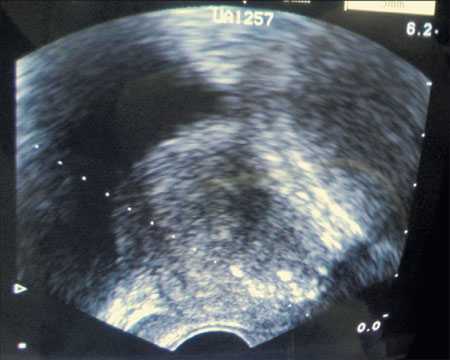
Лечение. В условиях дневного стационара пациенту под аппликационной анестезией под ультразвуковым контролем трансректально в предстательную железу было введено 200 ЕД Лантокса (2 инъекции в каждую долю по 50 ЕД соответственно). Препарат разведен в 8 мл стерильного физиологического раствора. Для проведения процедуры использовался ультразвуковой аппарат с трансректальным датчиком и насадкой для проведения биопсии и игла для эндоскопических вмешательств Ch 5 (рисунок 1).
ФГУ «НИИ урологии Росмедтехнологий», Москва
Рисунок 1. Трансректальная УЗ навигация интрапростатического введения препарата Лантокс пациенту Х.

Процедура наведения иглы под контролем ТРУЗИ идентична таковой при биопсии простаты.

Результаты. Динамика основных клинических показателей до и в различные сроки после введения БТА представлена в таблице 1.

При анализе результатов через 5 месяцев отмечено клинически значимое уменьшение симптомов по шкале IPSS c 13 до 8 баллов, клинически значимое увеличение максимальной объемной скорости мочеиспускания (Qmax) с 14 до 22 мл/сек., а также достоверное уменьшение объема предстательной железы с 68 см3 до 34 см3. По данным опросников, клинически значимого изменения показателей половой функции у пациента не зарегистрировано.

Таким образом, через 5 месяцев после интрапростатического введения БТА пациенту с СНМП и ДГПЖ достигнуто:

  1. уменьшение симптомов по шкале IPSS;
  2. увеличение объемной скорости мочеиспускания;
  3. атрофия (уменьшение объема) предстательной железы.

Заключение. Полученный результат позволяет сделать вывод о возможности ботулинотерапии СНМП при ДГПЖ. В настоящее время мы наблюдаем еще 5 больных на разных сроках после интрапростатического введения БТА (Лантокс). После получения статистически значимых данных можно будет сделать более достоверные выводы о перспективности данного метода коррекции симтомов при ДГПЖ.

Ключевые слова: ботулинический токсин типа А, доброкачественная гиперплазия предстательной железы, симптомы нижних мочевых путей.

ЛИТЕРАТУРА

  1. Каприн А.Д., Иванов С.А., Клименко А.А. Уроантисептическая терапия в лечении лучевого цистита у женщин. Российский научный центр рентгенрадиологии МЗ РФ. 2005.
  2. Галил-Оглы Г.А., Каприн А.Д., Титова В.А., Паклина О.В., Чазова Н.Л., Клименко А.А. Функциональные и морофологические изменения нижних мочевых путей в процессе лучевой терапии на органы малого таза. М. 2004.
  3. Chuang Y.C., Kim D.K., Chiang P.H., Chancellor M.B. Bladder botulinum toxin A injection can benefit patients with radiation and chemical cystitis. BJU Int. 2008 Sep; 102 (6): 704-6.
  4. Chuang Y.C., Tu C.H., Huang C.C. et al. Intraprostatic injection of botulinum toxin type-A relieves bladder outlet obstruction in human and induces prostate apoptosis in dogs. BMC Urology 2006; 6:12.
  5. Kuo H.C. Prostate botulinum A toxin injection an alternative treatment for benign prostatic obstruction in poor surgical candidates. Urology 2005; 65: 670-4.
  6. Park D.S., Cho T.W., Lee Y.K., LeeY.T., Hong Y.K., Jang W.K. Evaluation of short-term clinical effects and presumptive mechanism of botulinum toxin type A as a treatment modality of benign prostatic hyperplasia. Yons Med J 2006; 47: 706-14.
  7. Larson T.R., Scottsdalle A.Z., Huidobro C. et al. Intraprostatic injection of botulinum toxin in the treatment of symptomatic LUTS, including sequential MRIs for accurate changes in size of the prostate. J Urol 2005; 173 (suppl): 376.
  8. Guercini F., Giannantoni A., Bard R.L. et al. Intraprostatic botulin toxin injection in patients with severe benign prostatic hyperplasia: a multicenter feasibility study. J Urol 2005; 173 (suppl): 376-7.
  9. Silva J., Silva C., Saraiva L. et al. Intraprostatic botulinum toxin type A injection in patients unfit for surgery presenting with refractory urinary retention and benign prostatic enlargement. Effect on prostate volume and micturition resumption. Eur Urol 2008; 53: 153.
  10. Maria  G., Brisinda G., Civello I.M., Bentivoglio A.R., Sganga G., Albanese A. Relief by botulinumtoxin of voiding dysfunction due to benign prostatic hyperplasia: Results of a randomized, placebo-controlled study. Urology 2003; 62:.259-64.